
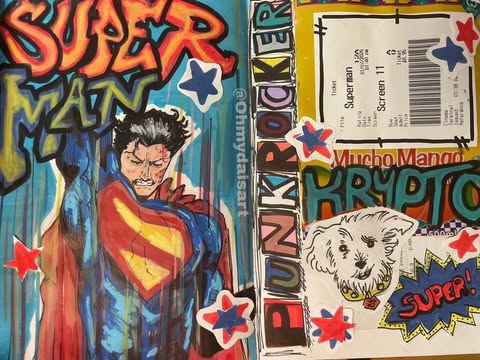
What do you think of when you think of a superhero film? Hope and salvation? Meta-humanoids with preternatural abilities? Corporations and political commentary? Kupiainen uses a quote from Steven Spielberg as an anchor in his essay: ‘We were around when the Western died, and there will be a time when the superhero movie goes the way of the Western’ [1]. I would argue that the traits defining a hero surpass any period, making the superhero genre timeless.
2025 has been off to a fantastic start for heroes. Marvel has released three well received motion pictures (Captain America: Brave New World, Thunderbolts and Fantastic Four: First Steps) but DC’s Superman has trumped all of them by grossing 502 million US dollars worldwide. This blockbuster in particular will be the centre piece of my thesis, provided its remarkable relevance to the emotional renaissance. Fourth wave feminism combined with the rising backlash against AI has pushed us to become more emotionally aware and compassionate for our peers in the last few years[2]. Corenswet’s take on the legendary Superman character – clearly influenced by an amalgamation of the earliest DC comics[3] – has traits of wit and integrity at his core, presenting a pure-hearted persona that seamlessly integrates humanity and divinity.
Part of Superman’s appeal to the largely male following he has received since his inception is his omnipotence: ‘Faster than an airplane, more powerful than a locomotive, impervious to bullets’[4]. In the essay ‘A Room of One’s Own’, Woolf resolves that the feeling of power over others has long been integral to the security of men, hence Superman’s allure. But this also means that any attack against patriarchy is seen as a personal attack against a man’s identity; ‘a protest against some infringement of his power to believe in himself’[5]. Given Superman’s dual personhood, he can hold space for both his machismo attitude that is influenced by his heritage, as well as his sensitive side as a liberated man in the 21st century. This triggers Lex Luthor who embodies patriarchy, favouring a power-hungry ideology and feigning ignorance to tenderness[6]. Especially in James Gunn’s version of the film, Superman is a highly emotional being, and he is not afraid to express this. The poignant scene at the end, memorable to most due to the ‘punkrocker’ theme that plays in to the credits, emphasises this point. Corenswet’s wide grin cannot be contained as pictures of his Earth family flick past on the screens around him, underscoring the import of feelings to what makes us human. Overall, Superman shows there is power in displaying your emotions as a man in the modern world as well as honour in custom, conveying the malleability of the superhero and its sustained relevance.
Applying Woolf’s concept that minorities act as a ‘looking glass’ which cis-normative men see themselves in, we can infer a parallel between Superman and those who feel fractured by patriarchy, or like they are constantly under scrutiny from the predominantly androcentric world we live in. Not only is he an advocate for others, but he has had first-hand experience with being alienated by the cultural environment he now calls home. Whether he is being shunned or idolised in the movie, his existence as a person (and not an ‘It’ as Lex Luthor refers to him) is overlooked. This is not dissimilar from the individuals depicted in the warzone at the boarder of Jahranpur and Boravia – or the people of Palestine and Israel in the real world – that he attempts to save[7]. Heroes like Superman that epitomize hope in the face of patriarchal structures motivate marginalized people to dare to break free from playing a role in another groups’ version of utopia (e.g. LuthorCorp). And they also educate us on major political and social issues.
Even the original superhero movies (think Batman, 1943) incorporated current events into the genre’s discourse, such as patriotism in the face of WW2[8]. Given politics will never die as a practice, governing how we live our lives, my theory that the superhero will always be topical is further supported. Other contemporary work focuses on equally popular subjects of interest relating to the time of its release. For example, Deadpool (2016, Tim Miller) utilizes a metanarrative tactic, breaking the fourth wall and satirising the hero genre in a postmodern fashion. Meanwhile, Doctor Strange (2016, Scott Derrickson) blends spirituality with science, reawakening ongoing debates as to whether mystical belief and logical reasoning can work hand in hand.
Superman might look tough on the outside, but he’s a punk-rocker at heart; no matter what his parents on Krypton might have wanted for him. Special thanks to @ohmydaisart for the beautiful piece I have used as this posts cover art. It inspired me to write the essay with emotions as the focus, and I hope you love it as much as I do!
Bibliography
- Ball State Daily ↩️
- 2025 The Era of Emotions: Navigating the Shift to Emotional Intelligence | Listen Notes ↩️
- DC Comics That Inspired James Gunn’s Superman Movie Explained ↩️
- The Adventures of Superman on the Radio ↩️
- A room of one’s own : Woolf, Virginia : Free Download, Borrow, and Streaming : Internet Archive ↩️
- Patriarchal Ideology Explained ↩️
- Is the new ‘Superman’ movie about the war in Gaza? Viewers clash over political subtext | The Times of Israel ↩️
- Superhero Movies Have Always Been Political ↩️
Link to Daisy’s Art Instagram: Instagram


