The post feminist era can be defined as the current cultural age in which we reside, wherein it is believed most goals of previous waves have been achieved and therefore feminism does not hold the same influence or importance as it once did[1]. Many scholars argue that ‘post feminism’ is a limiting and groundless notion, undermining the work still being done within the feminist community[2]. Others have considered the idea that post feminism isn’t about the rejection of older feminist movements, but rather the celebration of them, and that people have the choice to be activists or accept their position in society as it exists now[3]. But when does exercising your right to choose become more about further ensnaring yourself in the net of patriarchy?
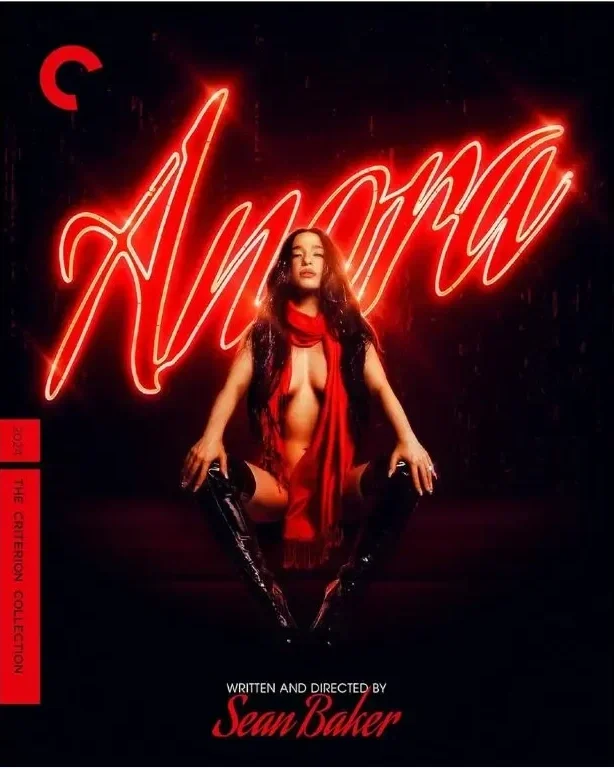
My preconceptions of Sean Baker’s latest achievement Anora were instructed by this idea: that to be a stripper, or ‘exotic dancer’ as the protagonist describes herself in the film, is not empowering but detrimental to the female sense of self. The piece, which came out in the UK in November last year, originally won the hearts of its audience through the strategic, gen-z focused marketing[4]. The use of Robin Schulz’s remix of Take That’s ‘Greatest Day’ I thought was a particularly effective hook in the promo clips, its lively driving beat interjected with the melancholic vocal tone of Barlow’s voice creating the perfect atmosphere for the romantic drama. However, watching the opening sequence where this theme is first used, I was immediately unsettled by what I felt was a stunning juxtaposition between a joyful, heartful piece of music and a track shot showing leering men. From the offset, we are forced to objectify the half naked women thrusting their arses towards the camera, aligned with the men that have paid for the lap dances. The zoom in on Mikey Madison’s big grinning face as the beat drops only emphasised the irony of the scene for me; I found it completely comical that something I perceived to be so tasteless was being romanticized and tailored to younger generations. It is common knowledge that sex is everywhere we look now, and especially the hyper sexualisation of the female form. ‘Adolescents learn about sex from media outlets… the more sexual content adolescents view, the more likely they are to experience early intercourse’[5]. This quote demonstrates how children are becoming exposed to sexual content way too early in their development, and although Anora has received an 18 certificate in the UK, this hasn’t stopped it from being popularized among younger fans who have seen it advertised all over TikTok and Instagram.
However, I would argue that the practice of glamorising sex work is, in itself, regressive and self-sabotaging. Emily Hone dismantles the concept of ‘the liberated sex worker’: ‘the commodification of women’s bodies is not freedom – it is a form of sexual and social subordination… reinforcing a power imbalance that defines sexual relations between men and women’[6]. Viewing the film through this lens, we can infer that the character Ani is oppressed by her work environment, trying to make ends meet day to day by exposing herself to physical harm and transactional intimacy with the guise of consent. Gill also makes a great point about how post feminism is ultimately tied to neoliberalism, catering to more privileged groups of women that have the freedom to choose and ignoring those with social and economic barriers[7]. This emphasises the naivety of idealized sex work, particularly in this scenario where Ani has an immigrant-adjacent status that has led her to this lifestyle.
This ideology set the foundation for my initial aversion towards the filmmaker, who I believed had simply conformed to social trends in order to make money. It wasn’t only the romanticization of prostitution that perturbed me, but the promotion of affluence and capitalism. Ivan splashes out like there’s no tomorrow, and the sanctity of the body is irrelevant as the group get wasted in Vegas and have IV hydration therapy so they can go again. I also felt that the dialogue was uninspired and cliché, making Madison look pretty unbecoming when she screams a dozen motherfuckers during the scene where Toros’ men break in to the mansion. I spent the whole 2 hours in the cinema trying not to fall asleep, and when it finally reached the denouement, I was left dissatisfied and confused. It wasn’t until I got out of the theatre and did my research that my perspective shifted slightly.
Sean Baker is known for his dedication to presenting minorities within his work, whether that be transgender women (Tangerine), children in poverty (The Florida Project)or male porn stars (Red Rocket). But something almost all of his films have in common is sex work. Plausibly, this isn’t a new focus in film. From Pandora’s Box (Georg Wilhelm Pabst, 1929) to Pretty Woman (Garry Marshall, 1990), directors have attempted to magnify the lives of these mysterious individuals who we are not supposed to talk about, often ultimately estranging them even further as shallow, erotic beings in need of saving. But Baker seems to take a realist, detached approach to filmmaking which allows his audiences to – in turn – be objective about what they’re consuming. Shortly after Ani’s introduction, we observe her from a wide shot amongst the booming ambience of the nightclub, trying to convince someone to go in to a VIP room with her. The sound is completely diegetic at this point, immersing us in the chaotic environment and exaggerating Ani’s vulnerability. The audience is encouraged to see her as a regular person, which is a blatant divergence from the titillating image of her grinding on top of a customer in the earlier shot. Realism is also central to Ani’s character arc. At HQ, she is ‘Ani’, the westernized, fun-loving girl who is up for anything (as long as she gets paid accordingly). Here she meets Ivan, and so she retains this second identity as their relationship evolves. But quickly, we realise this is only a mask that is starting to slip as she spends more time with the young Russian. When she first sleeps with Ivan, we get a glimpse in to her authentic self through a mid close up after he asks her if she knows the Russian band playing on his TV. Her eyes are wide and mocking at first, yet when she looks away her gaze turns soft and you can tell she is reflecting on that part of herself she has been out of touch with for so long. She explains to Toros multiple times that she goes by ‘Ani’, not ‘Anora’, affirming the rejection of her heritage. Nevertheless, the title of the film puts her full name in shining red letters, highlighting the journey she takes back to herself with the search for Vanya and the realisation that their relationship hasn’t been a fairy tale but a fable.
Broey Deschanel frames her argument with a quote from Jack Zipes: ‘We remember fairy tales to keep our sense of wonderment alive and to nurture our hope that we can seize possibilities to transform ourselves and our worlds’[8]. The magical realist genre of Baker’s films speaks to our inner child, such as in the scene when Anora is discussing her plans to go to Disney World for her honeymoon and Lulu equates her to Cinderella. With this in mind, I can re-assess the closing scene where Anora attempts to have intercourse with Igor in return for gifting her the ring. I ostensibly saw this part and imagined Madison’s character was being further stigmatized, transmitting that her sexuality is her only personality trait. On a second viewing, I am able to appreciate that Anora is not a sex symbol, but an imperfect person who is starved for love and finally breaks down to the only person that has shown her humanity. The fantastical elements of the music, plot and colour palette all aid in ensuring Baker’s intention to spread awareness of the reality of prostitution is realised, connecting us to the protagonist’s innocence despite our possible prejudices of her position.
Drawing my thesis to a close, I stand by a radical critique of the growing interest in postfeminist values in the media. In terms of Anora, though, I no longer believe Baker has taken a postfeminist attitude to the film. It seems the director has not used a conventional Hollywood format in order to diminish marginalized people. Instead, he has broken away from his usual Italian Neorealist approach and opted for a universally familiar style that communicates the struggles of subcultures in a more easily digestible manner. This could not be more important today given the widespread support for decriminalisation of sex work in order to create safer settings for escorts, and while I disagree with the existence of this occupation, I also recognise that the individuals who take on these roles are still worthy of respect[9].
Reference List
- Postfeminism – Wikipedia ↩️
- The Myth of Postfeminism on JSTOR ↩️
- Postfeminism – (Intro to Gender Studies) – Vocab, Definition, Explanations | Fiveable | Fiveable ↩️
- T-shirts, thongs and perfect twerking: Anora spent $18m on marketing – three times its budget | Anora | The Guardian ↩️
- Free Essay: Sex in the Media – 2367 Words | Studymode ↩️
- Opinion: The Myth of the ‘Liberated Sex Worker’ – Feminism or Patriarchy Rebranded? – The Witness Exeter ↩️
- Post-postfeminism?: new feminist visibilities in postfeminist times ↩️
- https://youtu.be/TJ2CPVTpbCk?si=UqLAmje2jSXhCGH0 (Why Anora is the Disney Princess We Need) ↩️
- Sex workers can tell you why sex work is work – speak to them | openDemocracy ↩️